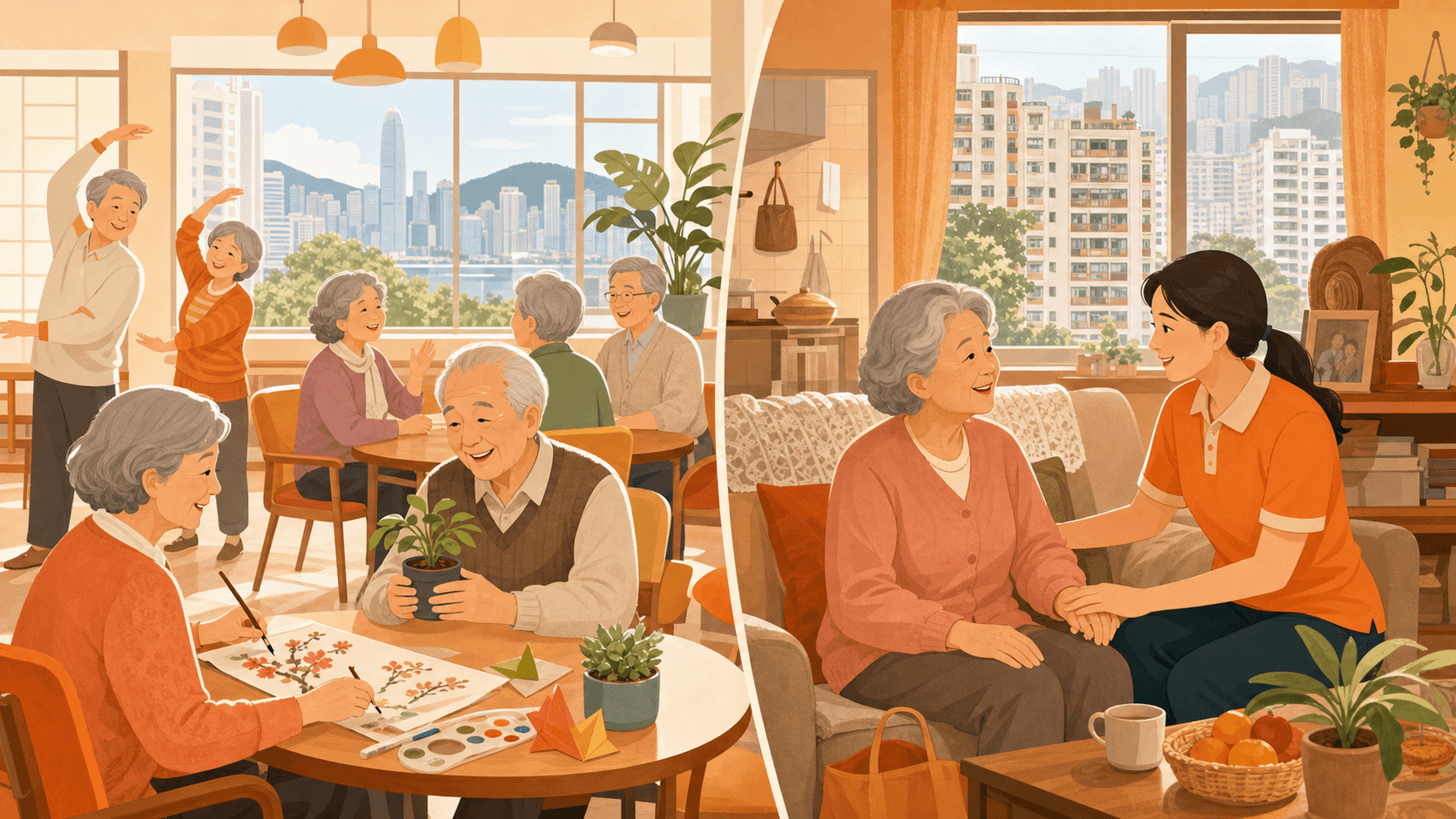
1. Ageing at Home vs Moving Into a Residential Care Home: Start With the Policy Direction
When parents begin to need daily care, many families first wonder: "Do we need to look for an elderly home?" Before making that decision, it helps to understand Hong Kong's broad elderly care policy direction: "ageing in place as the core, residential care as backup". In other words, government resources are prioritised to help older people continue living in their familiar home and community, while residential care is the fallback option when community support is no longer enough to meet their care needs.
"Community care services" are the set of services designed to support this direction. They mainly serve older people whose physical functioning has started to decline, but who can still live in the community: some need supervision during the day, some need home nursing or household support, and some want the flexibility to choose their own service mix.
The hardest situations are often borderline cases: an older person's condition sits somewhere between "community services may still be enough" and "a residential care home is needed". The good news is that Hong Kong's assessment and waiting-list system leaves room for this type of case (see the next section), so families do not have to choose only between "community care only" and "move into a home immediately". If you are unsure where your family member fits, you can start with the care home matching wizard -> for an initial view of care needs.
2. Getting Started: SCNAMES and the Central Waiting List
All subsidised long-term care services, whether community care or residential care, go through the same entry point: the Standardised Care Need Assessment Mechanism for Elderly Services (SCNAMES) together with the Central Waiting List (CWL), forming a one-stop assessment and registration gateway.
One Standardised Assessment Tool
Since July 2021, SCNAMES has used the updated assessment tool interRAI-HC 9.3 to objectively assess an older person's level of care need. The assessment is carried out by accredited assessors: specially trained social workers, nurses, occupational therapists or physiotherapists.
The mechanism covers two service streams: community care services (CCS) and residential care services (RCS). One assessment can open both doors for the older person.
Flexibility for Borderline Cases
Because one assessment maps to both service streams, borderline cases have the flexibility of a dual option:
- Use community services while waiting for a residential care home: an older person assessed as suitable for residential care may also use community care services during the wait for a residential care place, instead of simply waiting without support.
- Temporarily become a "non-active case" and stay in the community: if the older person and family decide to continue living in the community for the time being, the residential care application may be changed to a "non-active case". If the person's health later deteriorates or the need changes, the family may request reactivation as an "active case" at any time, without having to queue again from the beginning.
Five-Step Application Process
Applications for SCNAMES assessment and Central Waiting List registration can be handled through social workers at Medical Social Services Units, Integrated Family Service Centres or elderly centres in five steps:
- Contact a social worker and make an application;
- An accredited assessor conducts the standardised assessment for the older person;
- Suitable services are matched according to the assessment result (community or residential);
- Register on the Central Waiting List and wait in order;
- Once a service is arranged, the older person formally starts receiving care.
Not sure where to begin? The care home matching wizard -> can help you organise care needs and district preferences before connecting them with the process above.
3. Day Care Centres/Units for the Elderly (Including Bought Place Scheme)
For older people who need care during the day but still want to return home at night, day care centres/units for the elderly are one of the core community care services.
Who It Serves and What It Aims to Do
Day care services are for frail older people aged 60 or above who have been assessed under SCNAMES as having moderate or severe impairment, including older people with dementia. The aim is to help older people maintain physical functioning and continue ageing in the community, while giving family carers a break during the day.
Service Places
As of 31 March 2025, there were 102 day care centres/units for the elderly across Hong Kong, providing 4,183 places. The Government has continued to increase day care places in recent years to ease waiting pressure.
Fees
The monthly fee for subsidised day care is set as a proportional subsidised fee based on the older person's financial circumstances. For short-term day respite use, separate fees apply:
- Day respite service for elderly persons: HK$41.5 per day;
- Day respite used through CCSV: HK$21 per session.
Bought Place Scheme
In addition to directly subsidised centre places, the Government also purchases places from suitable service units through a Bought Place Scheme to increase the overall supply of day care and ease waiting pressure. While waiting for a subsidised place, families can ask the social worker about the availability of bought places as well.
4. Frail Elderly Home Care Service (Newly Integrated From April 2026)
If the older person mainly needs home nursing and household support, the corresponding service is the Frail Elderly Home Care Service.
Note the New Name
From 1 April 2026, the former Enhanced Home and Community Care Services (EHCCS) and Integrated Home Care Services (Frail Cases) have been integrated into one service called "Frail Elderly Home Care Service". If you have previously heard of EHCCS or "IHCS (Frail Cases)", they now refer to this integrated service. The name is unified to make application and identification easier.
Who It Serves
The service is for frail older people aged 60 or above who are living in the community and have been assessed under SCNAMES as having moderate or severe impairment.
Service Scope
Using a case management approach, the service provides a basket of home and community support according to the older person's needs:
- Case management: dedicated coordination and follow-up on the care plan;
- Nursing service: home nursing, wound care and health care;
- Rehabilitation training: physiotherapy, occupational therapy and related support;
- Meal service: meal provision or meal delivery;
- 24-hour emergency support: response to urgent situations;
- Respite service: short breaks for carers.
Fees
Fees use a sliding scale based on the older person's financial circumstances: those with greater means pay more, and those with fewer means pay less.
Service Places
As of 31 March 2025:
Service | Teams | Places |
|---|---|---|
Integrated Home Care Services (IHCS) | 61 teams | 4,120 frail case places + 15,562 home helps |
Enhanced Home and Community Care Services (EHCCS) | 31 teams | 9,245 places |
(The above shows the distribution of teams and places before integration. After integration, they are managed under the unified Frail Elderly Home Care Service.)
5. Integrated Home Care Services (Ordinary Cases) / Home Help Service
Not every older person who needs support is "frail". For older people and families with mild impairment in physical functioning, or with other social needs, the corresponding service is Integrated Home Care Services (Ordinary Cases): a home-based community support arrangement.
Who It Serves
The ordinary-case service has a wider service target, covering older people aged 60 or above, persons with disabilities, and families with social needs.
Priority Cases
The service will give priority to the following cases with greater need:
- Low-income persons with weak personal and family support systems;
- Applicants who are waiting for Integrated Home Care Services (Ordinary Cases);
- Service users who have left Enhanced Home and Community Care Services or Integrated Home Care Services (Frail Cases).
Fees
Home support for ordinary cases also charges relevant fees according to service nature and user circumstances. Overall, it is less intensive than frail-case care. For exact fees and available places, check with the service team in the relevant district.
6. Community Care Service Voucher for the Elderly (CCSV)
If you want to choose the service provider and service combination freely, rather than being assigned to a designated centre, the Community Care Service Voucher for the Elderly (CCSV) was designed for this purpose.
"Money-Following-the-User" Model
CCSV uses a "money-following-the-user" operating model: the Government subsidy is attached directly to the older person, who can choose suitable recognised service providers. At the same time, fees are shared under an "affordable users pay more" principle according to the older person's ability to pay.
Subsidy Amount (2026-27)
For 2026 to 2027, the CCSV voucher value is HK$4,526 to HK$10,824 per month, depending on the older person's assessed care need level.
Co-Payment Levels
Older people must pay a certain co-payment percentage according to household financial circumstances. There are six levels: 5%, 8%, 12%, 16%, 25%, 40%. The lower the financial capacity, the lower the co-payment percentage, with the lowest level at 5%.
Eligibility
To apply for CCSV, the older person must meet all of the following:
- Has completed a SCNAMES assessment;
- Has registered on the Central Waiting List (CWL);
- Is not currently receiving subsidised community care services or residential care services.
Application and Approval
The Social Welfare Department issues application invitations to eligible older people according to the invitation order on the Central Waiting List. After an application is submitted, approval can generally be completed within four weeks.
Regularised Scheme
CCSV was regularised in September 2023, with the cap then set at 10,000 vouchers; in 2022-23, about 9,000 older people used the scheme. The Government then added 1,000 vouchers in 2024-25, increasing the cap to 11,000 vouchers. For comparison, in 2022-23, subsidised home-based and centre-based community care services had about 27,000 users, while home help services had about 26,000 users. This shows the overall scale of community care is substantial, with CCSV being the most flexible part of the system.
7. Comparison Table: Community Care vs Residential Care (How Borderline Cases Can Choose)
The table below places three community care services alongside residential care, so families handling borderline cases can quickly see the differences:
Item | Day Care Centre for the Elderly | Frail Elderly Home Care Service | Community Care Service Voucher (CCSV) | Residential Care Services (RCS) |
|---|---|---|---|---|
Who it serves | 60+, moderate/severe impairment, incl. dementia | 60+, living in the community, moderate/severe impairment | Assessed, registered on CWL, not receiving subsidised CCS/RCS | Assessed under SCNAMES as suitable for residential care |
Care location | Centre during the day, home at night | Delivered at home | Older person chooses provider (home-based/centre-based) | 24-hour care in a residential care home |
What you get | Function maintenance, social contact, carer respite | Nursing, rehab, meals, 24h emergency support, respite | "Money-following-the-user" flexible service mix | Full-day accommodation and care |
Fees | Proportional fee based on financial circumstances; respite HK$41.5/day | Sliding-scale fee based on financial circumstances | Monthly voucher value HK$4,526-10,824, co-payment 5%-40% | Residential care home fees (depends on subsidised/private place) |
Entry and waiting | Through SCNAMES + CWL five-step application | Through SCNAMES + CWL five-step application | By CWL invitation order, around 4 weeks for approval | Through SCNAMES + CWL; can become "non-active" and stay in the community |
Key reminder for borderline cases: you do not have to choose in black-and-white terms. An older person assessed as suitable for residential care may use community services as a bridge while waiting, or change the residential care application to a "non-active case" and continue living in the community, without having to queue again later. If you have decided that residential care homes need to be compared, go to the care home ranking -> to filter by fees, care staff ratio and other indicators.
8. How to Start / FAQs / Related Resources
Step One: Find the Right Person to Handle the Application
Applications for community care services are handled by social workers through SCNAMES and the Central Waiting List. You can contact:
- Medical Social Services Units (social workers in hospitals);
- Integrated Family Service Centres;
- Social workers at your local elderly centre.
Support Hotlines
Save these phone numbers in your mobile phone:
Purpose | Phone |
|---|---|
Social Welfare Department hotline | 2343 2255 |
Carer Support Hotline | 182 183 |
Emergency (elderly safety under threat) | 999 |
Pre-Application Checklist
- [ ] Is the older person aged 60 or above and currently living in the community?
- [ ] Has a social worker arranged the standardised assessment (interRAI-HC 9.3)?
- [ ] Has the older person registered on the Central Waiting List?
- [ ] Are you looking for day care, home nursing, or a self-selected service mix (CCSV)?
- [ ] If this is a borderline case, have you understood the flexibility of the dual option / "non-active case" arrangement?
Related Resources
- Care home matching wizard -> - answer a few questions to get personalised service and care home suggestions;
- Care home ranking -> - use this when community support is not enough and you need to compare residential care homes;
- Elderly community support resources guide -> - learn about elderly centres, the Senior Citizen Card, elder abuse prevention, respite care and other community support networks;
- FAQ -> - one-stop answers about applications, waiting, fees and community services.
Understanding the policy direction of "ageing in place as the core" and making good use of community care resources around you is the first step in making long-term care decisions for your parents.