1. Introduction: Caring for Parents Is Not Only About “Moving Into a Home”
When parents grow older and daily living starts to require support, many adult children first ask: “Do we need to look for an elderly home?” In reality, before residential care becomes necessary, Hong Kong has a fairly complete community support network. Elderly centres across all 18 districts, different types of respite care, and elder abuse help channels are all designed to help older people age at home, in a familiar community, for as long as possible, while also easing pressure on carers.
This guide organises those resources in a directory-style format. You will see where to seek help, who is eligible, how to apply, and which number to call in urgent situations. If, by the end, you find that your family member's care needs are already beyond what community services can carry, the final section will help you move toward residential care matching.
To quickly assess care needs and get personalised suggestions, you can use the home matching wizard → at any time.
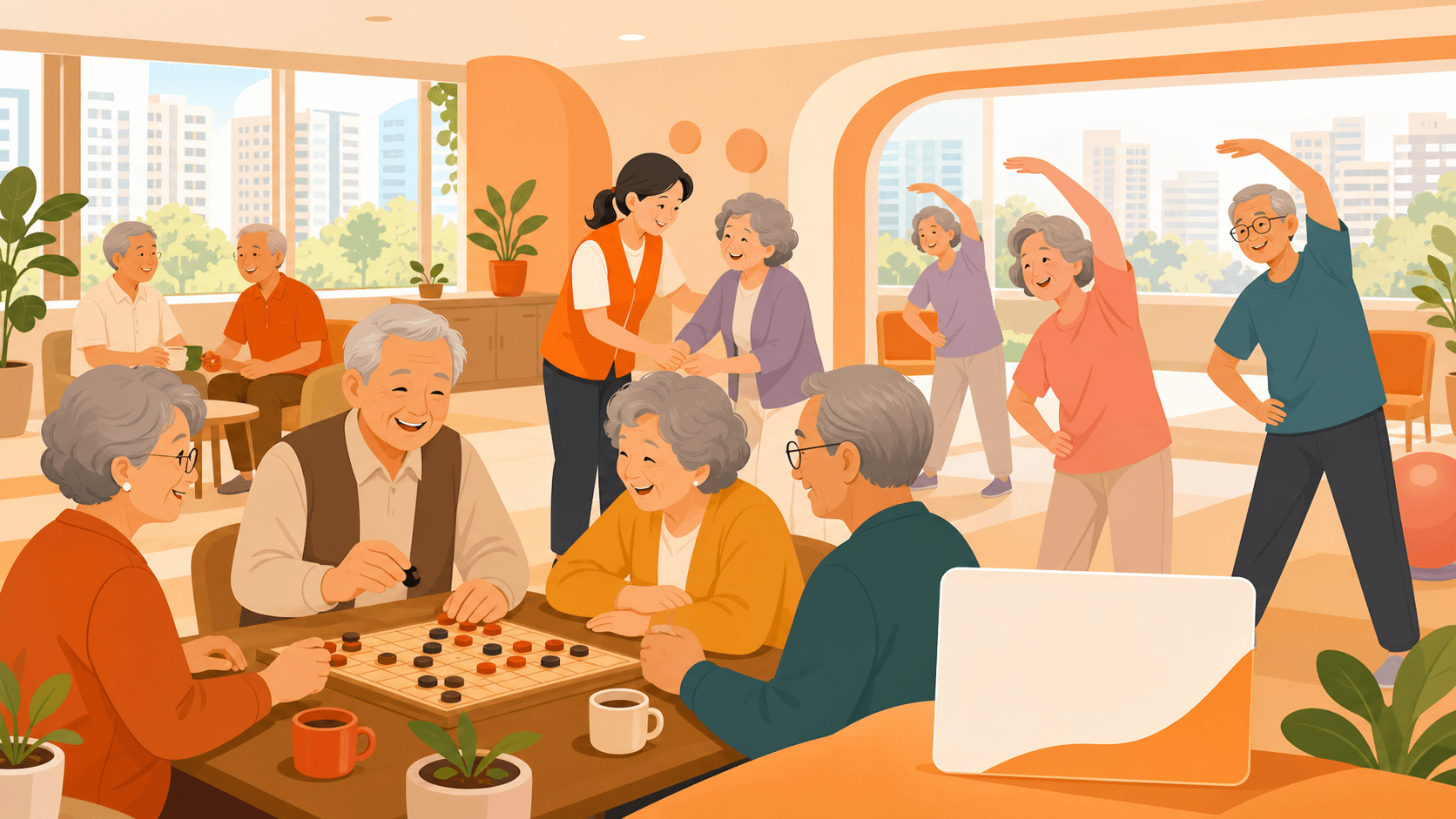
2. District Elderly Community Centres and Neighbourhood Elderly Centres (DECC / NEC)
District Elderly Community Centres (DECCs) and Neighbourhood Elderly Centres (NECs) are often the “first stop” for community elderly care. They are also a main entry point for carers who need to understand and apply for different services.
The roles and mission of the two types of centres
The mission of DECCs is to help older people live healthily and with dignity in the community. These centres do more than run leisure activities. They also handle older people's long-term care and counselling needs directly, and accept referrals. DECCs also have Support Teams for the Elderly, encouraging older people to join volunteer service and support one another.
NECs operate closer to neighbourhood level, with a smaller service catchment. They complement DECCs and make it easier for older people to use support near home.
Services provided
The two types of centres provide a broad range of services, including:
- Education and development activities — interest classes, health talks and social activities
- Carer support — information, emotional support and stress relief for carers
- Outreaching services — proactive contact with hidden or singleton older people
- Counselling services — support for emotional, family and adjustment issues
- Meal services — meals at centre or meal delivery
- Referral services — referrals to long-term care, medical or other social services
- Drop-in service — older people may use centre facilities when needed
Service users and referral routes
Centres mainly serve older people living in the community and their carers. Older people may go to a centre directly for drop-in service and general activities. They may also be referred by family members, medical social workers or other service units for more in-depth services such as counselling, carer support or long-term care assessment. For many families, an elderly centre is also a place to register for the Central Waiting List and apply for residential care and community care services.
How to find a nearby centre
The Social Welfare Department lists DECCs and NECs across Hong Kong on its website. You can search by Hong Kong Island, Kowloon or the New Territories to find the nearest centre. It is best to call the centre directly to check opening hours and make an appointment for counselling.
3. Senior Citizen Card
What it is used for
The Senior Citizen Card is a general proof of age issued by the Social Welfare Department. Cardholders can enjoy elderly concessions and discounts at government departments, public transport operators and participating merchants. For older people and carers, it is a simple but useful form of identity proof, avoiding the need to show an identity card and calculate age every time.
Eligibility
Any Hong Kong resident aged 65 or above is eligible to apply for a Senior Citizen Card. Eligibility is counted by date of birth.
How to apply
There are several application channels for the Senior Citizen Card, so older people with different needs can choose the most suitable one:
Application method | Processing time | Notes |
|---|---|---|
By post | Card mailed within 7 working days | May apply 60 days before the 65th birthday |
In person | Completed on the same day | Suitable when the card is needed quickly |
Online eForm | Submitted through an electronic form | Can apply for the electronic version with “iAM Smart” |
Fees
- First application: free
- Electronic Senior Citizen Card through iAM Smart: free
- Replacement physical card: HK$25 (effective from 1 March 2024)
Enquiries
For questions, call the Senior Citizen Card Office at 3583 2959 for application details.
4. Preventing Elder Abuse and Protecting Older People
Caring for an older person can be stressful, and family relationships may sometimes become strained. Understanding what “elder abuse” means and where to seek help protects the older person, and can also bring support before a carer reaches breaking point.
What is elder abuse?
The Social Welfare Department has the Procedural Guidelines for Handling Elder Abuse Cases (2025 revised edition). Together with the framework of the Domestic and Cohabitation Relationships Violence Ordinance (Cap. 189), it sets out how elder abuse cases are defined and handled.
Definitions of the six types of abuse
According to elderly community care and protection information, elder abuse is generally divided into six types:
Type | Definition |
|---|---|
Physical abuse | Inflicting physical injury or pain on an older person by non-accidental means |
Psychological abuse | Causing mental or emotional suffering to an older person through words or behaviour |
Financial abuse | Improperly using or taking an older person's property or resources without consent or through deception |
Neglect | Failing to provide the basic care, food, clothing, medical care or safety protection an older person needs |
Abandonment | A person with care responsibility abandons an older person or stops fulfilling that responsibility |
Sexual abuse | Any sexual contact or sexual act with an older person without consent |
Latest case statistics
The Social Welfare Department's elder abuse case statistics show that 120 newly reported elder abuse cases were recorded in the first quarter of 2026, with physical abuse making up the largest share:
Type of abuse | Number | Share |
|---|---|---|
Physical abuse | 91 cases | 75.8% |
Financial abuse | 11 cases | 9.2% |
Multiple abuses | 9 cases | 7.5% |
Psychological abuse | 7 cases | 5.8% |
Sexual abuse | 2 cases | 1.7% |
Neglect | 0 cases | — |
Abandonment | 0 cases | — |
The same SWD page also provides historical statistics from 2021 to 2025 for download, which can help families understand longer-term trends.
Help and reporting channels
If you suspect an older person is being abused, or if you as a carer feel you can no longer cope, you can seek help or make a report through the following channels:
- A social worker or the older person's elderly centre (DECC / NEC)
- An Integrated Family Service Centre
- A hospital Medical Social Services Unit
- The Police (call 999 in an emergency)
- The SWD hotline 2343 2255
Seeking help early is not “airing family problems in public.” It is a responsible step to protect the older person and the carer.
5. Other Community Resources: Respite and Community Care
Long-term caring pressure accumulates. “Respite service” gives carers a short break and acts as a safety valve before physical and emotional exhaustion becomes too much.
Residential respite service
When a carer needs to be away briefly, such as for work travel, hospitalisation or simply rest, an older person may be arranged to stay in a residential care home for short-term residential respite, helping relieve carer pressure.
- Service users: Older people aged 60 or above who are physically suitable for communal living
- How to apply: Must be referred by a social worker
- Enquiries: Carer Support Hotline 182 183; SWD hotline 2343 2255
Day respite service
Day respite provides short-term day care, so an older person has support during the day and can still return home at night.
- Service users: Older people aged 60 or above who are not currently receiving residential care
- Enquiries: Carer Support Hotline 182 183
Community Care Service Voucher
The Community Care Service Voucher uses a “money-following-the-user” model: government subsidy is paid directly to the service chosen by the older person, and fees are shared according to the older person's ability to pay under the “affordable users pay” principle. For families who want an older person to stay at home but need day care or home support, it is an option between “family care only” and “moving into a residential care home.”
For further comparison between community care and residential care, see the related answers in the FAQ →.
6. Help Hotlines and Contacts
Save these numbers on your phone, so you do not need to search from scratch when something happens:
Purpose | Phone |
|---|---|
Carer Support Hotline | 182 183 |
Social Welfare Department hotline | 2343 2255 |
Senior Citizen Card Office | 3583 2959 |
Emergency police report (e.g. abuse) | 999 |
Tip: The Carer Support Hotline 182 183 provides 24-hour information and emotional support, and can also help arrange respite services. If an older person's safety is under immediate threat, call 999 at once.
7. When Should You Consider Residential Care?
Community support is rich, but it does not fit every situation. When the following signals appear, it is time to seriously assess residential care:
- The older person's care needs have risen to a level requiring 24-hour professional care, and family members plus day or respite services can no longer cope;
- The carer is experiencing serious physical and emotional exhaustion, and even respite care is no longer enough to relieve it sustainably;
- Falls, wandering, medication mistakes or other safety incidents have happened more than once;
- The home environment cannot be modified to a safe level.
If your family is at this turning point, the next steps can be:
- Use the home matching wizard → — answer a few questions about care needs, budget and district to get personalised suggestions on suitable residential care home types;
- View the residential care home ranking → — when community support is not enough and residential care is needed, compare homes across Hong Kong by fees, care staff ratio and other indicators;
- Browse individual home details (for example, /homes/<home-code>) — look deeper into the fees, facilities and assessment information for a specific home;
- FAQ → — get one-stop answers on residential care applications, waiting lists, fees and community services.
Whether your family ultimately chooses community care or residential care, understanding the resources around you is the first step toward making a better decision for your parents.